
The Thesis
Golf is unique among sports because it is played on a field of infinite variables, yet we approach it with a mindset demanding robotic precision.
The average golfer stands over the ball believing that a 'good' shot must fly dead straight, land softly, and stop three feet from the cup. Anything less is a failure.
This pursuit of perfection is the greatest barrier to improvement.
To play your best golf, you must abandon the idea that you can perfect your swing. Instead, you must learn to master your imperfections.
Dr. Bob Rotella, the preeminent sports psychologist of the modern era, argues that this acceptance is the foundation of mental durability:
"Golf is a game played by human beings. Therefore, golf is a game of mistakes."
Dr. Bob Rotella
Jack Nicklaus, the greatest champion of the modern era, bluntly states:
"Golf, in essence, is a game of misses."
Jack Nicklaus
Tiger Woods, who chased perfection harder than perhaps anyone, concurs:
"Golf is not a game of perfection; it is one of reality."
Tiger Woods
The Conflict
The history of golf instruction is a tug-of-war between the ideal of mechanical perfection and the reality of human error.
On one side stands Ben Hogan, the patron saint of ball-strikers.
In Five Lessons, Hogan posits that the average golfer is 'entirely capable of building a repeating swing and breaking 80.'
Hogan's philosophy is seductive. It suggests that if you just master the grip, stance, and posture, you can build a machine that produces the same result every time. He writes with the conviction that 'there is an explanation for everything that takes place,' implying that errors are simply failures of knowledge or execution.
On the other side stands the wisdom of Bobby Jones, Jack Nicklaus, and Tom Watson.
While they valued fundamentals, they rejected the idea of a robot-like swing.
Bobby Jones noted that golf 'becomes more and more difficult the longer one plays it,' acknowledging that the game is a living, breathing struggle.
Jack Nicklaus admitted his dream of 'flawless automation' was a fantasy.
Tiger Woods bridges this gap but lands firmly in the reality camp.
While he famously overhauled his swing multiple times in a Hogan-esque pursuit of mechanical efficiency, his assessment of the results is sobering. He notes that Hogan claimed to hit only four perfect shots in a week.
Tiger's own standard is even starker:
"I won 12 times around the world in 2000... and I only remember hitting one shot I would call perfect."
Tiger Woods
If the most dominant player in history hits only one perfect shot a year, why do you expect to hit twelve a round?
The Science
Modern data vindicates Nicklaus, Jones, and Woods.
Mark Broadie, the father of the 'Strokes Gained' analytic revolution, uses the PGA Tour's ShotLink data to shatter the myth of the perfect shot.
In Every Shot Counts, Broadie introduces the concept of shot dispersion.
We tend to believe that pros hit the ball laser-straight because television only shows their highlights. The reality is much messier.
Broadie found that even the best players in the world have significant 'directional error.' On a full swing, a Tour pro's shot pattern resembles a 'bra shape'—missing both left and right of the target.
The Reality Check:
Broadie's data shows that a pro from 160 yards averages a proximity of about 30 feet from the hole. They do not stiff it every time.
If you expect to hit a 7-iron to 10 feet, you are holding yourself to a standard that even Tiger Woods doesn't maintain.
The Synthesis (Best Practice)
How do we reconcile Hogan's demand for high mechanical standards with the acceptance of error preached by Rotella and Woods?
We must separate Training from Trusting.
1. Train It, Then Trust It
Dr. Rotella introduces a critical distinction between the "Training Mentality" and the "Trusting Mentality."
On the range, you may work on Hogan's mechanics. But on the course, you must abandon them.
"You cannot hit a golf ball consistently well if you think about the mechanics of your swing as you play."
Dr. Bob Rotella
You must trust the swing you brought with you today, flaws and all.
2. Accept Your Arc
Stop trying to hit the ball straight.
Tom Watson, who dominated links golf by controlling his trajectory, says bluntly:
"I try to make every shot drop either left or right. A straight shot's an accident."
Tom Watson
You likely have a natural curve. Do not fight it. Aim to allow for it.
3. The 90% Rule
Dave Pelz suggests you should never hit a shot unless you have '90% confidence' in the outcome.
If you stand over a shot fearing a slice into the water, you have already failed. Aim away from trouble so that your miss is safe.
4. Conservative Strategy, Cocky Swing
This is the ultimate synthesis of the mental and physical.
Rotella advises players to pick a conservative target (away from hazards) but to make a "cocky swing" at that safe target.
Indecision causes tension; accepting a safe target allows you to release the club freely.
Key Concept
“"Golf is a game of misses." — Jack Nicklaus "Golf is a game of mistakes." — Dr. Bob Rotella”
The Drill
The Safety Zone Drill
Goal: To visualize shot dispersion, remove the pressure of perfection, and practice the "Trusting Mentality."
The Setup:
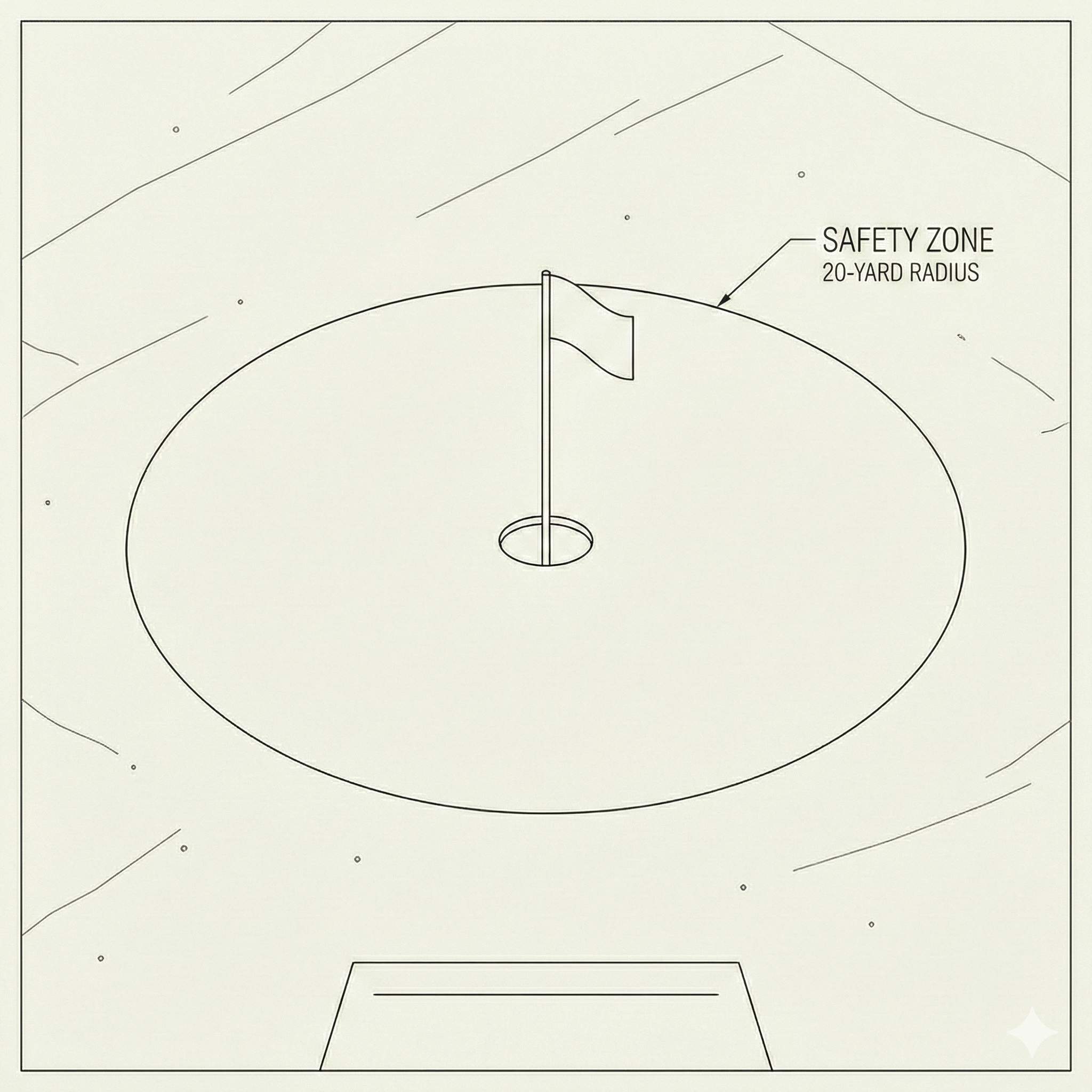
On the driving range, pick a target flag about 150 yards away.
Instead of aiming for the stick, visualize a Safety Zone—a large circle around the flag with a 20-yard radius (roughly the size of a green).
The Action:
Hit 10 shots with a mid-iron.
Before each shot, go through a full routine where you visualize the ball landing anywhere in that large circle.
- Do not think about your swing mechanics.
- Look at the target.
- Look at the ball.
- Swing.
Scoring:
- If you hit the flagstick: 0 points (It's luck, ignore it)
- If the ball lands inside the 20-yard Safety Zone: 1 point
- If the ball lands outside the zone: -1 point
The Mindset:
Notice how your tension drops when your goal is simply to 'hit the circle' rather than 'hit the pin.'
This is the feeling of the Trusting Mentality.
The Lesson:
A ball on the green, 30 feet from the hole, is a success. It is not a missed opportunity for a birdie; it is a successful avoidance of a bogey.
"I try to think success... to see good shots, not bad ones."
Jack Nicklaus
By widening your target, you increase your success rate, build confidence, and paradoxically, you will find yourself hitting it close more often.